A new report by Deloitte shows that the social damage caused by Dutch agriculture exceeds the economic returns of the sector each year. Commissioned by the Robin Food Coalition and the Food Transition Coalition, Deloitte calculated a negative balance of €5.3 billion per year.
Revenues versus costs
The study The Hidden Bill: Reshaping Dutch Agriculture shows that agriculture has an added value of €13.3 billion, while the social costs amount to €18.6 billion per year. These costs are caused by, among other things, greenhouse gas emissions, nitrogen and ammonia, loss of biodiversity and effects on water quality and health.
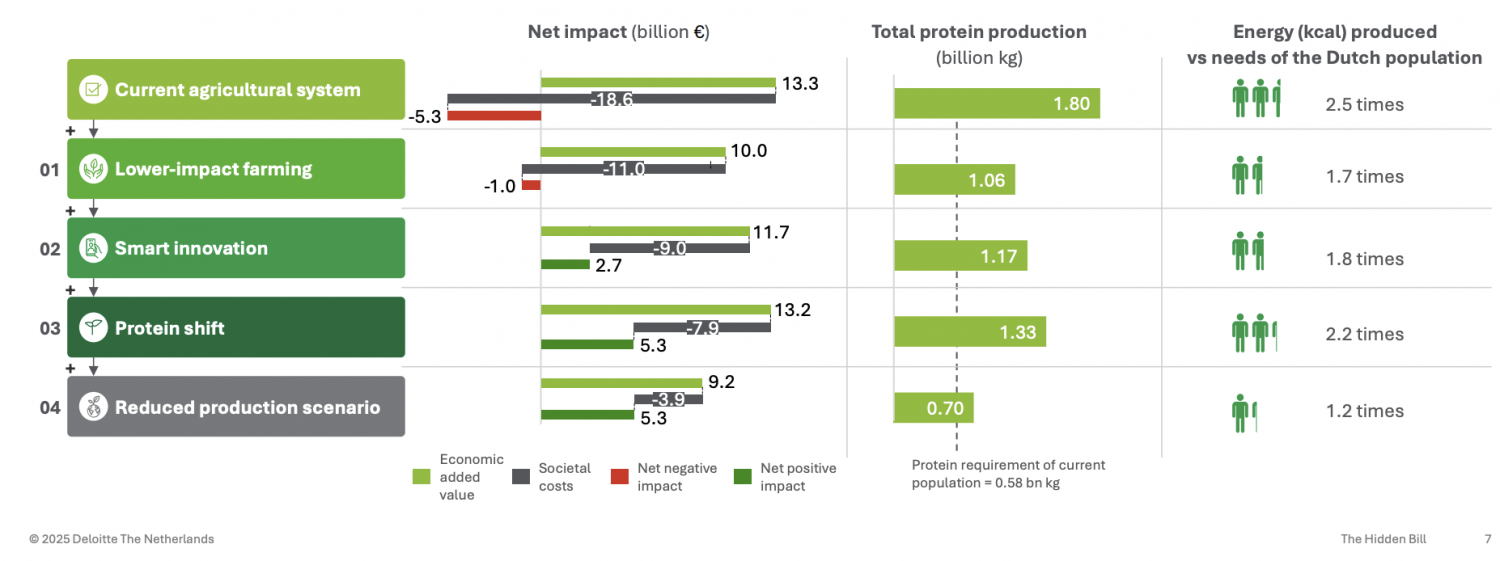
The largest items are greenhouse gas emissions (€7.9 billion), nitrogen/ammonia (€7.2 billion) and biodiversity loss (€2.5 billion). According to agricultural economist Krijn Poppe, the report underlines the urgency: "I am surprised by the scale of these social costs," says Poppe. "Nevertheless, the calculations are conservative, as they have to be in a study like this. It's about providing a solid indication. These figures show that the problem is acute."
Perspective through sustainable options
Nevertheless, the study also offers perspective. With a shift towards sustainable (organic) cultivation, smart innovation and a shift to plant-based proteins, the social balance in the Netherlands could shift to a positive €5 billion per year.
Titus Bekkering of the Robin Food Coalition: "Agriculture seems to add economic value, but in a broader social context it is out of balance. We must now focus on agriculture with far fewer chemicals, synthetic fertilizers and imported animal feed, in which soil health and biodiversity are central. This requires cooperation between market players and the government to structurally increase sustainable agricultural land and make sustainable products more accessible."
About the research
The Hidden Bill: Reshaping Dutch Agriculture was carried out by Deloitte on behalf of the Robin Food Coalition and the Food Transition Coalition. The analysis quantifies, for the first time, the social costs of the Dutch agricultural and food system and compares them with alternative pathways to make the sector more sustainable. The calculations are based on available data, assumptions from recognised standards and knowledge sources, and insights from interviewed experts.
For those who want to read more, the full report can be downloaded here.
The analysis focuses on the Netherlands, but the themes are relevant more broadly across Europe. We are curious to see how similar calculations would look for other countries.