What will the global food system look like in 2050? A new peer-reviewed study by the renowned International Food Policy Research Institute (IFPRI) maps out the key developments. Its conclusion: global food demand will continue to grow, but where that growth takes place – and the conditions under which food can be produced – are changing significantly.
For fruit and vegetables, IFPRI expects global demand to grow by around 25% between 2025 and 2050, representing more than 470 million tonnes of additional demand. More than 90% of this growth will come from Africa, Asia and Latin America. Population growth and rising incomes in particular are driving greater and more diverse food demand in these regions. This creates new opportunities for the fresh produce sector. At the same time, global fruit and vegetable consumption remains below dietary recommendations.
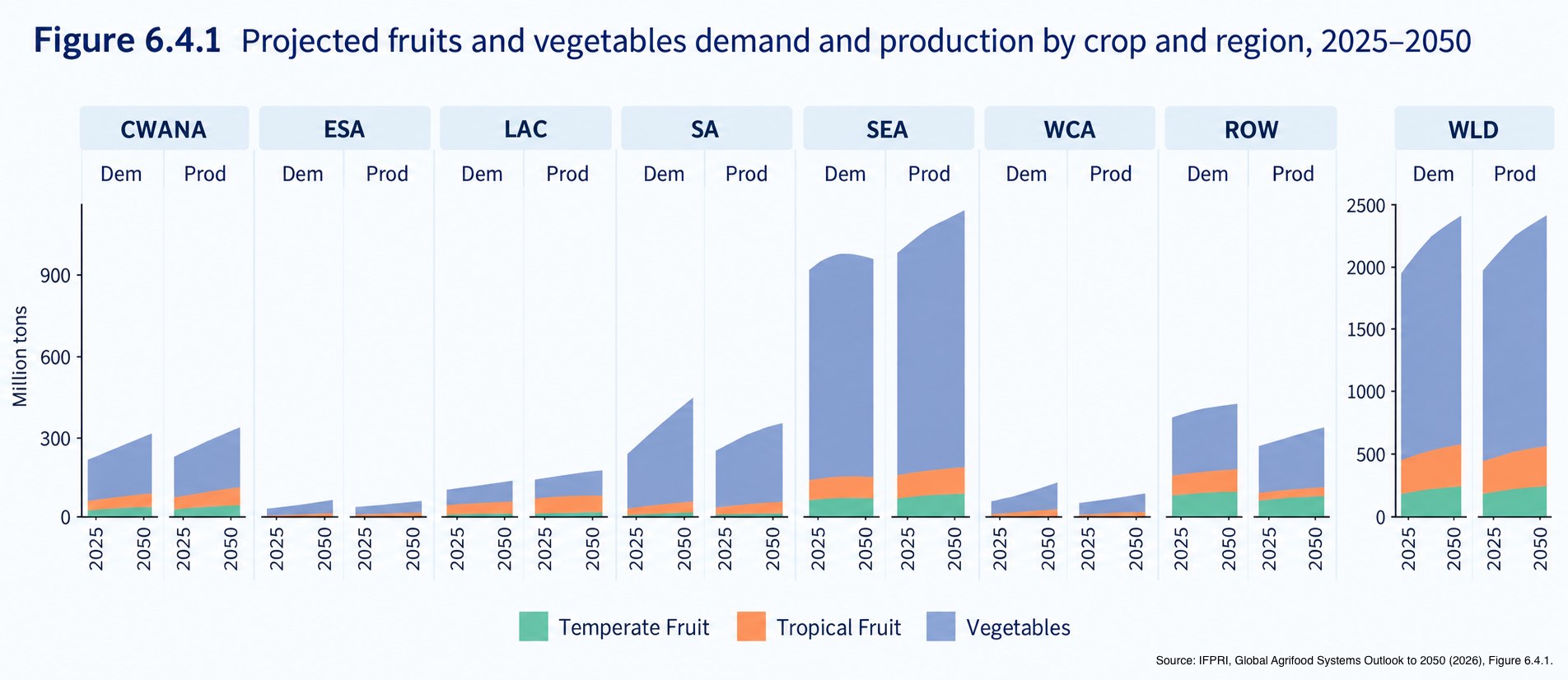
On the production side, risks are increasing. Higher yields and technological development will remain important, but climate change is slowing productivity growth. The impact varies considerably by crop and production region: some regions may benefit from changing temperatures or rainfall patterns, while others will face increasing pressure from heat and water stress. The use of land and water is also expected to increase.
International trade will change as a result. Some regions will become more dependent on imports, while Latin America will remain an important fruit-exporting region. At the same time, IFPRI projects an average increase in real fruit and vegetable prices of around 12% by 2050.
For the fresh produce supply chain, the report highlights one point in particular: future availability is not only about producing more, but also about where and how production takes place and which natural resources are used. Diversifying origins, careful water use and long-term cooperation with growers are therefore becoming increasingly relevant.
IFPRI was founded in 1975 and is a research centre of CGIAR, the world’s largest international agricultural innovation network. The figures in the report are scenario outcomes rather than forecasts. The study looks ahead to 2050 based on assumptions relating to population growth, income, technology and climate, among other factors.
Read the full study here: IFPRI – Global Agrifood Systems Outlook to 2050