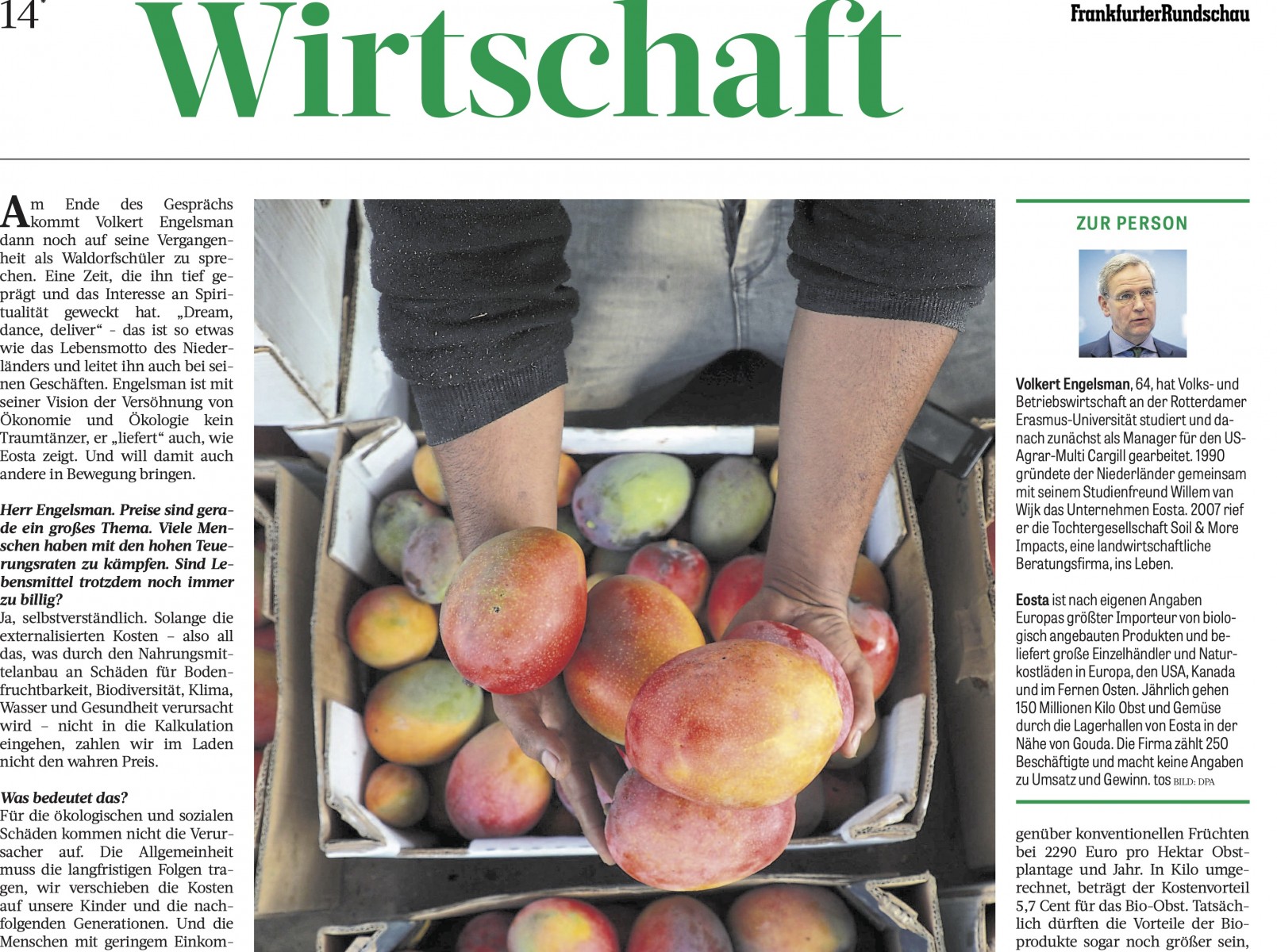
In August, prominent German daily Frankfurter Rundschau published a company portrait of Eosta / Nature & More. The portrait featured Eosta's beautiful organic mangoes, but also questioned CEO Volkert Engelsman about True Cost Accounting, the new approach to deal with the hidden costs in our economy. If applied correctly, True Cost Accounting will make non-sustainable production more expensive, while sustainable production becomes cheaper.
In Germany, the right approach to True Cost Accounting is currently the subject of debate; on one side stand corporates such as BASF, Porsche and Deutsche Bank who have united in the Value Balancing Alliance; while on the other side stand sustainable pioneers such as Eosta, HiPP, Gepa, Lebensbaum, Martin Bauer Group, Primavera and GLS Bank; their vision is represented by think tank TMG and Soil & More Impacts (SMI). Recently, tey released the True Cost Accounting handbook "TCA AgriFood Handbuch", which was created especially for the agricultural sector. Companies can download this handbook for free.
In the interview in Frankfurter Rundschau, the interviewer asks Volkert Engelsman, among other things, whether he still thinks that the prices of food are “too low”, now that inflation is rising so much. "Of course," says Engelsman. "As long as the hidden costs - i.e. everything that damages the soil, biodiversity, climate, water and health - are not included in the price calculation, we will never pay the true price." The interviewer objects that many citizens are already in money problems. Engelsman has a solution though: the government should lower the VAT on fruit and vegetables to 0%. That would be good for prices, for health and for the environment.
True Cost Accounting is not about increasing the cost of living, on the contrary. If applied correctly, at the source - the polluter, it will make sustainable production cheaper and unsustainable production more expensive. By shifting costs to the polluter, he is forced to produce more sustainably. And it is always much cheaper to prevent damage at the source than to repair the damage when the whole process is finished. This becomes particularly clear especially in crisis situations. For example, we see now that the production costs of green power are currently much lower than the production costs of fossil-fuel based power.
Read the entire interview here: https://www.fr.de/wirtschaft/wir-zahlen-im-laden-nicht-den-wahren-preis-lebensmittel-true-cost-91709016.html