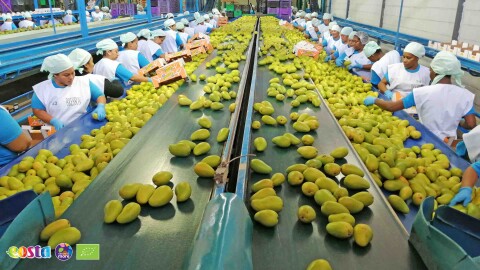
Phyllis Mugo (40), a single mother of four children, works in the warehouse of Mavuno in Nairobi, where she packs avocados into boxes. She lives in a single-room house with her four children and feels that she is neither prosperous nor poor. Her wage enables her to pay her rent, food bill and school fees, but then there is very little left over. However, since this Spring she has had two new dreams: opening a grocery store and buying a plot of land where she can build her own home. This is because she recently started receiving a real Living Wage.
Phyllis Mugo (40), a single mother of four children, works in the warehouse of Mavuno in Nairobi, where she packs avocados into boxes. She lives in a single-room house with her four children and feels that she is neither prosperous nor poor. Her wage enables her to pay her rent, food bill and school fees, but then there is very little left over. However, since this Spring she has had two new dreams: opening a grocery store and buying a plot of land where she can build her own home. This is because she recently started receiving a real Living Wage.
View the new video on our Living Wage avocados here
Anthony Ngugi’s 83 warehouse employees receive a real Living Wage, thanks to retailers and consumers in Europe who purchase the organic Living Wage avocados of Nature & More. A Living Wage is a wage that enables breadwinners to provide a dignified life for their families. It is significantly higher than a minimum wage, which supports little more than survival.
Gert-Jan Lieffering, Q&D manager at Eosta, regards Living Wages as one of the most important steps towards social sustainability because it tackles an entire trio of problems. “A Living Wage ensures that not only the basic requirements such as food and shelter are met, but also makes education and healthcare possible, and gives people the option to make substantial improvements in their lives. This creates social stability and has an effect that permeates society.”
People’s lives are changed by 2 cents per kilo of avocados
In principle, all Eosta customers participate. Eosta saves 2 Euro cents per kilogram of avocados sold, which is then used to bridge the gap to the Living Wage. The wage gap of the upcoming year is bridged with the money saved from the previous year and is paid as a bonus in addition to the normal wage. This makes Anthony’s avocados the first Living Wage avocados in the world, which is totally new in the fruit and vegetable trading sector.
Not 1300 liters, but 0 liters of water
These organic avocados are not only social, but also ecologically sustainable. This is why we call them “all-inclusive.” In the first place, Anthony’s avocados have a Blue Water footprint of zero. And this is while the average avocado has an average water footprint of 1300 liters, as recently calculated by the RIVM (Dutch National Institute for Public Health and the Environment). The Kenyan avocados are cultivated with rainwater. There are two annual rainy seasons, and the soil has a high water retention capacity due to Mavuno’s organic cultivation method, which means that irrigation water is not required.
No pesticides, just agroforestry
These are also first-class avocados from the perspective of biodiversity and the climate. They are grown by smallholder growers in a varied agroforestry environment. So, no monocultures, pesticides and artificial fertilizer, but a wealth of biodiversity. They are shipped to the Netherlands by sea, which produces a low level of emissions for transport per kilogram.
More info: