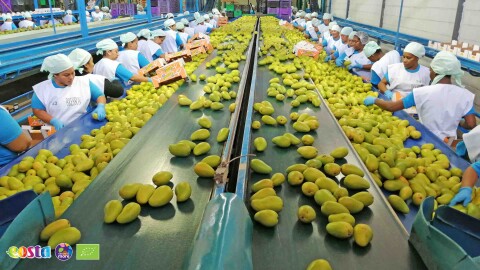
Eosta has become the first SME fresh produce supplier in the world to carry out a Living Wage assessment for a supplier. Eosta calculated the Living Wage gap for the workers of its mango supplier Fruiteq in Burkina Faso. The assessment shows that an additional cost of 10 cents per kilo of mangoes would suffice to close the pay gap for all 199 employees. Together with customers and consumers, Eosta will put this process in motion.

Eosta has become the first SME fresh produce supplier in the world to carry out a Living Wage assessment for a supplier. Eosta calculated the Living Wage gap for the workers of its mango supplier Fruiteq in Burkina Faso. The assessment shows that an additional cost of 10 cents per kilo of mangoes would suffice to close the pay gap for all 199 employees. Together with customers and consumers, Eosta will put this process in motion.

A Living Wage is a wage which covers not only the basic needs of food, shelter and clothing for a family, but also allows for education, health care and a small reserve for unforeseen life events. There are several social certification schemes which monitor and improve working conditions, but there is no label yet that guarantees a Living Wage. Social labels usually check that workers receive minimum wages, but in poor countries this is usually below Living Wage.
Many NGOs are doing research on Living Wages, but economic reality mostly ignores them. Volkert Engelsman, CEO of Eosta, explains why this is the case: “Companies that pay much more wage than the market, can simply not compete in our current economic system. Our economy is structured in such a way that the externalization of costs is rewarded, while social and economic sustainability are punished in accounting and therefore also by the financial market.”
He continues: “However, at Eosta, we are determined to break through that mechanism. We initiated our True Cost of Food campaign in 2017 to change just that. In organic farming Honesty, Ecology, Health and Care are the four basic principles. We aim to have a positive impact on people's health and quality of life through our trade. By assessing the Living Wage gap, we can now empower customers and consumers to make a conscious choice.”
Quality manager Gert-Jan Lieffering, who leads the project in Burkina Faso, explains the next steps: “Mangoes are the first product for which we assessed the Living Wage gap. As of May 14, we will offer our customers the opportunity to purchase Living Wage-inclusive mangoes for a premium of 10 cents per kilo. At the end of the season, the collected premium will be used at Fruiteq to achieve a structural wage increase for the workers. After the mangoes, we will do the same for pineapples.”
Living Wages are of great importance for a sustainable future. Engelsman explains: “If we fail to work towards Living Wages in developing countries, the wealth gap will grow. In the long run, these costs will inevitably come back to us through migration waves or social unrest, since we live in a global village. So far, social capital has been mostly ignored in True Cost Accounting. Living Wages can help us to monitor, manage, market and monetize our impact.”
On May 14, Eosta launches a new website about Living Wage under the Nature & More brand: www.livingwage.eu. The full Living Wage assessment report on Fruiteq SARL can be downloaded on the website.