What is the true cost of food? Eosta teams up with German food manufacturers, a bank and an NGO to publish the True Cost Accounting AgriFood Guide, enabling firms to measure hidden costs of production. It is now available for download.
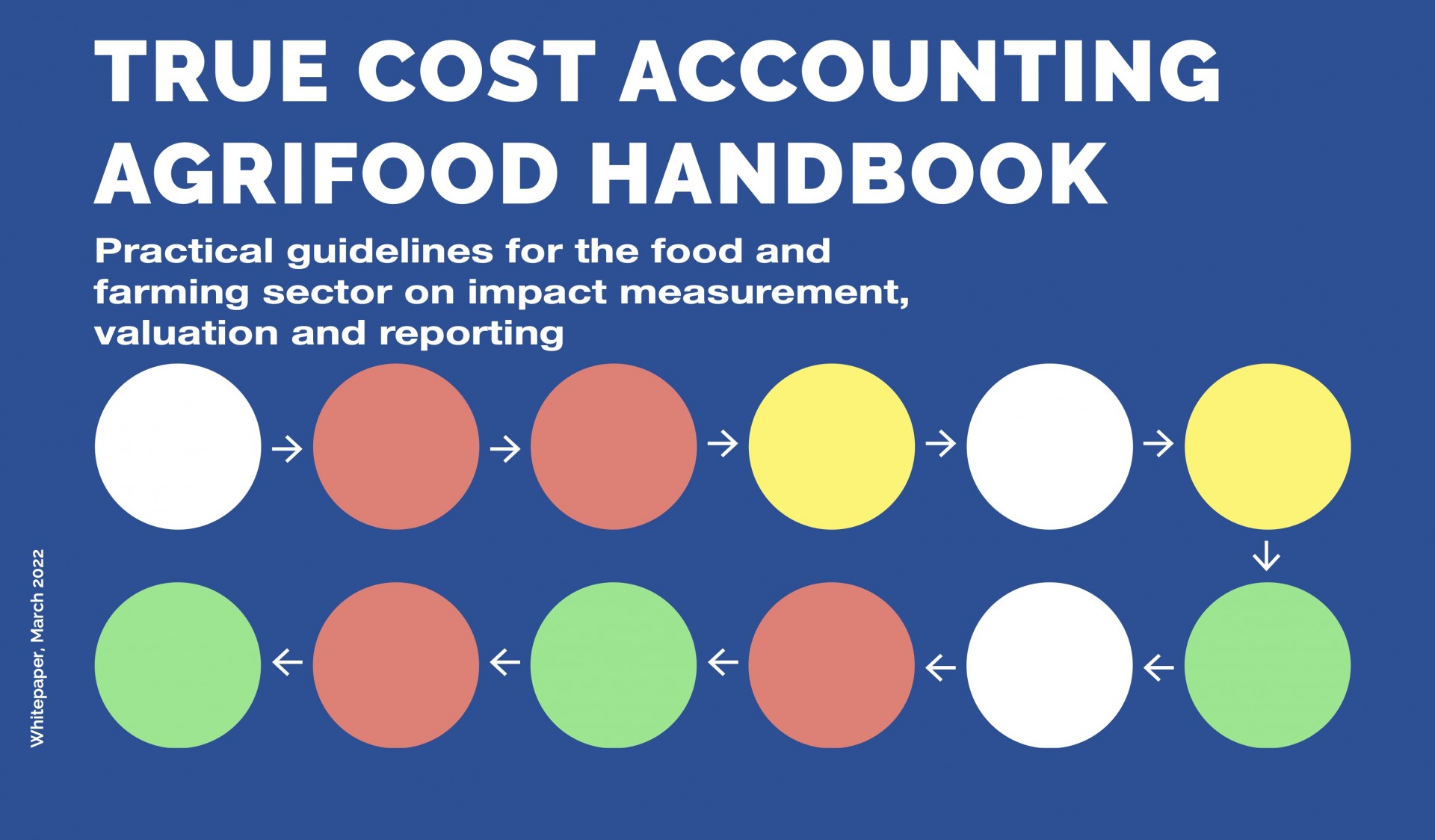
On the 10th of March, the new True Cost Accounting AgriFood handbook was presented in Germany at the UN FSS National Dialogue “Eating Together Sustainably”. You can download the True Cost Accounting AgriFood Handbook here.
The handbook offers firms a practical method and guidance to measure and price the previously hidden costs along their entire value chains. Based on this understanding, companies and political decision-makers can take specific measures to reduce the negative impact of food production.
Globally, the market value of all food consumed is estimated at US$9tr. However, the cost to the environment and society is estimated by independent organisations at US$19.8tr, more than double that figure.
These hidden costs are not borne by companies and are often passed on to other countries, especially in the Global South, and future generations. Conversely, measures to conserve biodiversity from sustainably managed farms also remain invisible. The way food and agricultural goods are produced affects our environment, health and society in many ways. The negative or positive effects on the climate, soil fertility or water pollution are not reflected in the prices in the supermarket.
To make companies take responsibility, Eosta and it's project partners see the need for a change in accounting practices. As does the German coalition government, which stated that “ecological and social values should be integrated into existing accounting standards in dialogue with the private sector”.
The initiative, named 'True Cost - From Costs to Benefits in Food and Farming' initiative is made up of a broad alliance, including Eosta, Gepa, Hipp, Lebensbaum, the Martin Bauer Group, Primavera, NGO Misereor and the GLS Bank. Led by consulting firms TMG and Soil & More Impacts, the initiative has been developing the True Cost Accounting AgriFood Handbook over the past three years in order to enable companies to measure and quantify any environmental and social effects comprehensively.
What is True Cost Accounting?
Only if the environmental and social impacts of food production are known can proposals for action and binding rules be formulated specifically to encourage companies to operate in a more sustainable manner. Measuring and quantifying these effects comprehensively is the goal of True Cost Accounting (TCA).
What is the added value of the True Cost Accounting AgriFood Handbook?
=> The handbook provides companies with a practical method and guidance to measure and price the previously hidden costs along their entire value chains of plant-based food or agricultural products.
=> Based on this understanding, companies and policy makers can take targeted measures to reduce the negative effects of food production.
Eosta, with its Nature & More consumer brand and transparency system, is Europe’s most innovative distributor of organic fruit and vegetables. Eosta is well known for its sustainability campaigns such as Living Wages, True Cost of Food and Dr. Goodfood. The company won the King William I Award for Sustainable Entrepreneurship in 2018, the European Business Award for the Environment in 2019 and the Eco-Logic Climate Change Award in 2021. See also www.esta.com and www.natureandmore.com.
END OF PRESS RELEASE
Contact and visual material:
Monique Mooij, Marketing Coordinator
E: monique.mooij@eosta.com
Marie-Ange Vaessen, Marketing Manager
E: marie-ange.vaessen@eosta.com
Telephone: 0180 63 55 500