In an era when consumers are becoming increasingly aware of their food choices, the pioneering research of A.W. Dänzer, founder of Soyana*, has added a new dimension to the understanding of organic food. Dänzer has spent years studying the difference between organic and non-organic foods by analysing their crystal structures. This research reveals surprising insights into the life energy of our food.
The method
Since 1996, Dänzer has been working in his own laboratory on a method to visualise the inner power of food. Using a unique crystallisation method, in which water droplets from food are frozen and observed under a microscope, he has captured the crystal structures of both organic and non-organic products.
Amazing results
The results are stunning: organic foods show complex, harmonious and symmetrical crystal structures, indicating high life energy and vitality. In contrast, non-organic foods are often found to have chaotic and disturbed patterns, indicating lower energetic quality.


The invisible visible
These findings offer visual confirmation of what many people already intuitively sense: organic food is not only healthier for the body, but also exudes an intrinsic power that is lacking in conventionally grown produce. The crystal images captured by Dänzer capture the imagination and make the invisible visible. Even without a scientific background, these images allow consumers to understand how food affects our well-being.
The importance of organic cultivation
Dänzer's work is of great interest not only to consumers, but also to everyone involved in food production and distribution. His research underlines the importance of organic farming and strengthens the case for a conscious choice of organic products.
More information
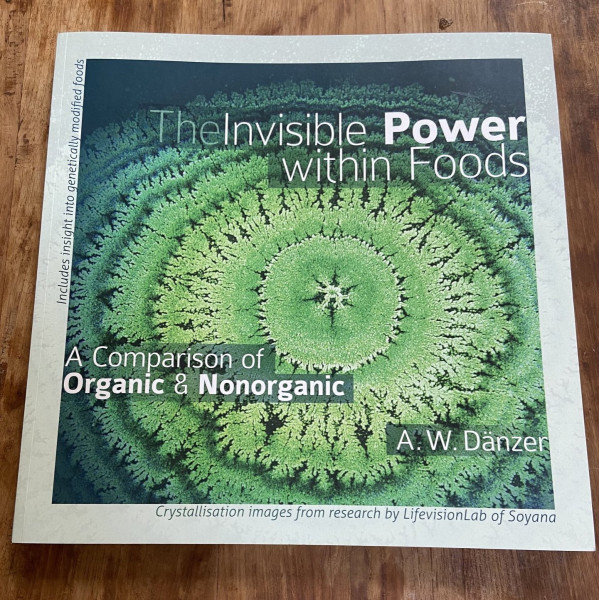
With his visual and scientific approach, A.W. Dänzer has made an important contribution to the debate on food quality and sustainability. His findings are collected in the photo book "The Invisible Power within Foods – A Comparison of Organic & Nonorganic", an essential reference work for anyone interested in the hidden power of food. The Invisible Power within Foods costs €29.80 and can be ordered in several languages via this site.
* a successful Swiss company, the first in Switzerland to offer sustainable meat substitutes.