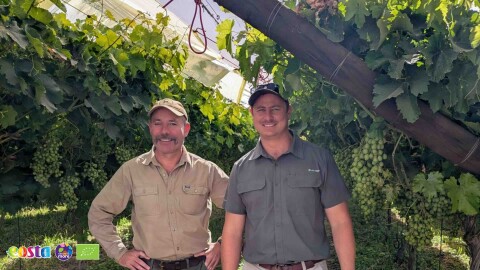
Day Zero is threatening Cape Town, New Delhi and, a few years from now, Europe. Organic agriculture is water smart and climate smart and is therefore a necessary solution for the increasingly long droughts. Volkert Engelsman and South-African grape grower Eddie Redelinghuys explain why.
Day Zero is threatening Cape Town, New Delhi and, a few years from now, Europe. Organic agriculture is water smart and climate smart and is therefore a necessary solution for the increasingly long droughts. Volkert Engelsman and South-African grape grower Eddie Redelinghuys explain why.
In the last months huge parts of Europe, including the Netherlands, Scotland, Ireland, Scandinavia, Northern Germany and Northern Poland where sighing under droughts. Fruit growers and farmers are expecting a smaller harvest. The grain harvest in the Baltic States is threatened. In Sweden the extreme drought is leading to a farmer’s crisis. And yes, climate change causes it, says prominent scientist Michael Mann of Penn State University in the Guardian.
Europe will have to deal with more prolonged droughts in the near future, says a study published this spring by a team of international scientists in Nature. The German Helmholtz Zentrum has stated at the beginning of 2018 that the number of droughts in Europe will increase with the rising temperature.
In the Netherlands, scientists Henny van Lanen ( Wageningen University) en Koen Zuurbier (Watercycle Research Institute) have argued that the country, which is partly below sea level, has been too focussed on preventing floods, and should now prepare for drinking water scarcity in the future by increasing the water stocks.
South Africa has given us a taste of what is yet to come. In the beginning of 2018 the complete water reserves of Cape Town, a city with three million inhabitants, became nearly exhausted. Eosta works with organic grape grower Eddie Redelinghuys in this area. His experiences demonstrate how organic agricultural is an important “soilution” to cope with major droughts (and floods) in the future.
Day Zero, the day on which the water supply would finish, seemed very close in Cape Town at the beginning of this year: on 22 April the tap would run dry. Media all over the world predicted social chaos. All inhabitants were put on a strict water ration. The possibility to tow in an iceberg from Antarctica was discussed.
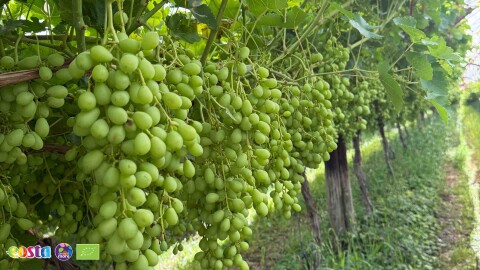
The three farms of organic grape grower Eddie Redelinghuys near Cape town however did much better that his conventional colleagues. Eddie still had water reserves in April, when other growers had completely used up theirs. For months, he was delivering water to his non-organic neighbour who grows cabbage and carrots and had finished his water allowance.
Instead of artificial fertilizer, Eddie uses compost. He keeps the soil covered in green manure instead of “cleaning” it with herbicides like glyphosate. His practices stimulate soil life and increase organic matter content, and thereby the water holding capacity. On sandy soils like South Africa has, this results in water savings up to 60%. And when the rain falls at last, the water is mostly absorbed, instead of washing away over a dry crust.
Worldwide 69% of all fresh water goes to agriculture, according to the Living Planet report by WWF in 2017. There lies a major key to dealing with climate change. The experiences of Eddie and other organic farmers are supported by many scientific studies which show that biological soils perform better in both situations with drought and flooding.
Examples are the decades-long field trials at the Rodale Institute in the US, or the recent publication "Organic Agriculture in the 21st century" in Nature, 2016. The UN’s Food & Agriculture Organisation FAO has published several papers stating that organic farming offers resilience to climate change.
A soil with a high humus content and rich soil life offers numerous other advantages too. The crops have better disease-resistance, so that the use of agrochemical pesticides can be greatly reduced; that is good news for the whole ecosystem. The soil not only stores more water, but also more carbon, so the climate problem is tackled at the roots.
The problems with the global water economy, which are a result of climate change, therefore scream for a large-scale switch to climate, soil and water-based organic agriculture.
Eventually, Day Zero in Cape Town was postponed till next year or the year after, but the danger remains imminent. The same goes for other places in the world. The Indian Times reported on 20 June that New Delhi and twenty other cities in India are risking to run dry in 2020. If we want drinking water from the tap in Europe in the future, we must opt for an agriculture that handles water, soil and ecosystems in a better way.
Volkert Engelsman, CEO Eosta / Nature & More, nr. 1 Dutch Sustainability Top-100 2017
Eddie Redelinghuys, biological grape grower, Cape Town